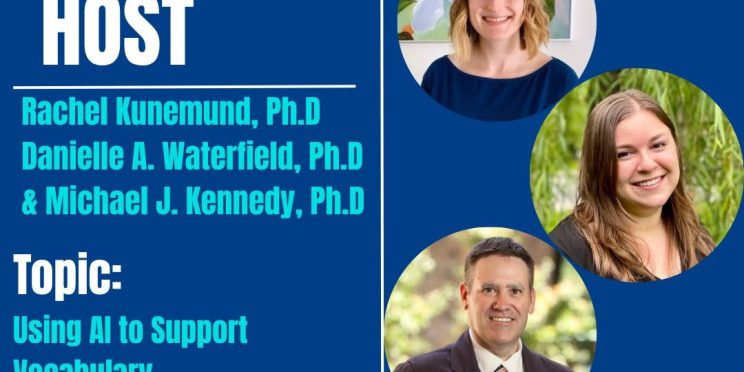
Let's Talk AI and Special Education with hosts Rachel Kunemund, Danielle A. Waterfield, and Michael J. Kennedy. Topic: Using AI to Support Vocabulary. Wednesday, November 4th at 1pm ET. Live on Zoom. Visit the link to join the Office Hours!

CIDDL Office Hours: Using AI to Support Vocabulary

Generative AI can save educators hours of planning, but only when educators keep every decision. In a recent CIDDL Office Hour, Dr. Olivia Fudge Coleman (University of Central Florida) and Dr. A.J. Naatz (University of Georgia) introduced AIDE: AI-assisted Inclusive Decision-making for Educators serving students with extensive support needs.
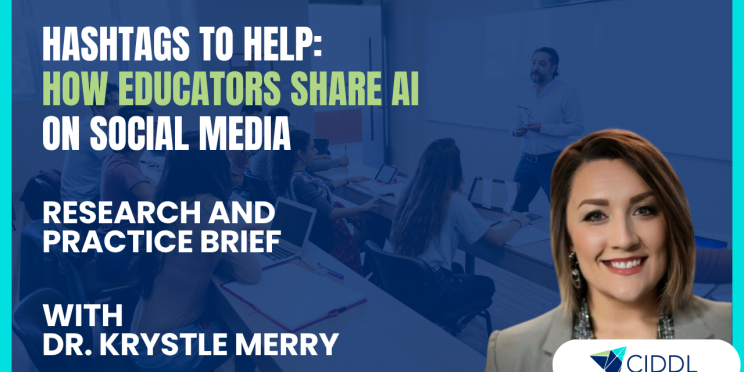
krystal merry headshot

Hashtags to Help: How Educators Share AI on Social Media

Educators increasingly turn to social media for informal professional learning, and artificial intelligence (AI) now ranks among the topics they share most (Merry et al., 2026). A review of 209 public TikTok videos identified 129 different AI tools used by educators and students, many to support students with disabilities (Merry et al., 2026). Research has not kept pace. Few studies examine how educators engage with AI on social media, and platform algorithms tend to promote catchy or familiar content over accurate content (Merry et al., 2026). Teachers may adopt a tool because a video went viral rather than because the tool meets a student’s need, protects student data, or works with assistive technology (Merry et al., 2026).
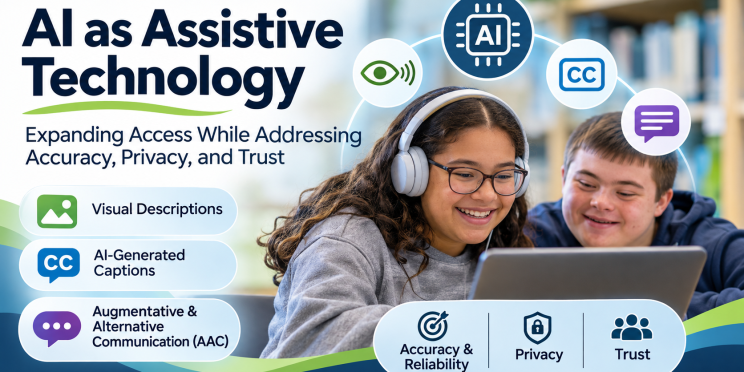
Two individuals using assistive technology on a laptop

AI as Assistive Technology: Expanding Access While Addressing Accuracy, Privacy, and Trust

Artificial intelligence (AI) is changing how people access information, communicate, and interact with the world. For people with disabilities, AI has the potential to serve as a powerful form of assistive technology: technology intended to “ increase, maintain, or improve the functional capabilities of people with disabilities” ( Assistive Technology Act, 2004).
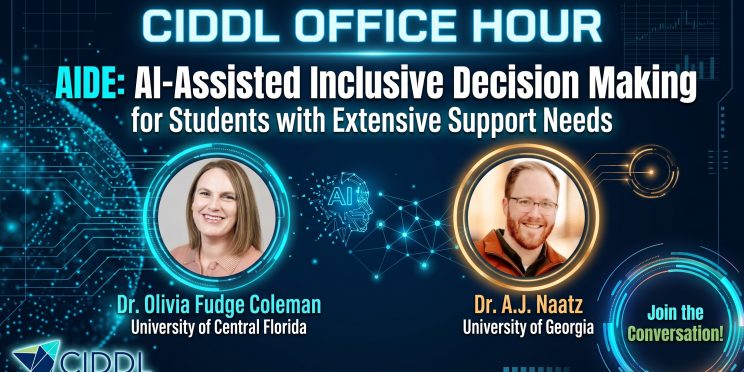
Headshots of Olivia and AJ

AIDE: AI-Assisted Inclusive Decision Making for Students with Extensive Support Needs

Generative AI can save educators hours of planning, but only when educators keep every decision. In a recent CIDDL Office Hour, Dr. Olivia Fudge Coleman (University of Central Florida) and Dr. A.J. Naatz (University of Georgia) introduced AIDE: AI-assisted Inclusive Decision-making for Educators serving students with extensive support needs.
the ciddl chat

Meet the Updated CIDDL Chat: Explore Evidence-Based Resources Through AI

What if you could explore CIDDL’s resources by simply asking a question? With the newly updated CIDDL Chat, educators, families, researchers, and other stakeholders can engage with CIDDL’s resources through an AI-powered conversational interface. During a recent CIDDL Office Hour, Daniel Neugent, a PhD student in Computer Science at the University of Kansas and a Graduate Research Assistant for CIDDL, introduced the updated CIDDL Chat, demonstrated its features, and answered questions about how the tool works.
classroom using devices at their desk

Research on the Screen Time Question

Screen time is often treated as a relatively homogeneous, duration-based construct, despite substantial differences in how, why, and in what contexts screens are used (Kaye et al., 2020). During this CIDDL Office Hours session, Dr. James Basham and Dr. Matthew Marino challenged that framing and discussed why understanding screen use in education requires a much more nuanced approach.
person looking at their cell phone at their desk with a laptop

Before the Phone Call: Using AI Simulation to Practice Family Engagement Conversations

Strong family-professional partnerships depend on communication, equality, trust, and respect (Blue-Banning et al., 2004), yet educators may have limited opportunities to rehearse these practices. Simulation in teacher preparation offers one way to practice, receive feedback, and reflect before higher-stakes interactions.
AI Community Challange

From Local Problems to Community Solutions: Join the Fall 2026 CIDDL AI Community Challenge

What could students improve in their community if artificial intelligence became a thought partner rather than an answer machine?
The Center for Innovation, Design, and Digital Learning (CIDDL) invites students and teachers in Grades 7–12 to answer this question through the Fall 2026 AI Community Challenge. Teams across the nation will identify a consequential local issue, investigate its causes, and design an evidence-informed solution with support from artificial intelligence (AI). The challenge places human reasoning at the center of every submission.
Chalkboard with writing

Designing AI-Integrated Learning Experiences for Pre-Service Teachers: A Real-Classroom Example

Artificial Intelligence (AI) is no longer a futuristic concept but a present reality that is reshaping how we teach and learn. Dr. James Basham, Yerin Seung, and I recognized that for pre-service teachers, developing a proactive attitude and the ability to leverage AI are fundamental competencies they must possess before entering the field. We designed our course to move beyond mere tool usage, aiming to foster a deep-seated AI literacy that balances technological benefits with pedagogical integrity. This post explores how we integrated AI into our curriculum to prepare the next generation of educators for a tech-driven classroom.

Office hours flyer

Beyond AI Adoption: Why Asking Better Questions About Privacy and Security Matters

Artificial intelligence (AI) has quickly become part of conversations about teaching and learning. Much of the discussion has focused on what AI can do for education—personalizing instruction, increasing accessibility, reducing teachers’ workload, or supporting student learning. As these opportunities continue to expand, schools are increasingly faced with another challenge that receives far less attention: How do we know whether an AI tool is trustworthy enough to use with students?