In our community chat, Let’s Talk AI and Special Education, on October 15, CIDDL focused on AI and Special Education Research. Our guest expert, Dr. Trey Vasquez, an associate professor at the University of Central Florida, introduced AI’s current state and future in education and delved into key basic research areas of AI in education and applied research topics.
CIDDL Community Chat: AI’s Impact on Special Education History
In our community chat, Let’s Talk AI and Special Education, on October 15, CIDDL focused on AI and Special Education Research. Our guest expert, Dr. Trey Vasquez, an associate professor at the University of Central Florida, introduced AI’s current state and future in education and delved into key basic research areas of AI in education and applied research topics.
Integration of Artificial Intelligence in Special Education Administration
CIDDL’s latest recorded webinar series highlights the authors of the special issue on Artificial Intelligence of the Journal of Special Education Preparation (JOSEP). JOSEP is a peer-reviewed, open-access journal dedicated to transforming research into practical applications for preparing special education teachers and leaders. The journal is published in partnership with and funded by Ball State University Libraries and the Teacher Education Division of the Council for Exceptional Children. It is edited by Dr. Andrew M. Markelz, with associate editors Drs. Argue Chitiyo, Benjamin S. Ridden, Margaret (Peggy) Weiss, and Naima Bhana Lopez. This blog post highlights several articles featured in this special issue.
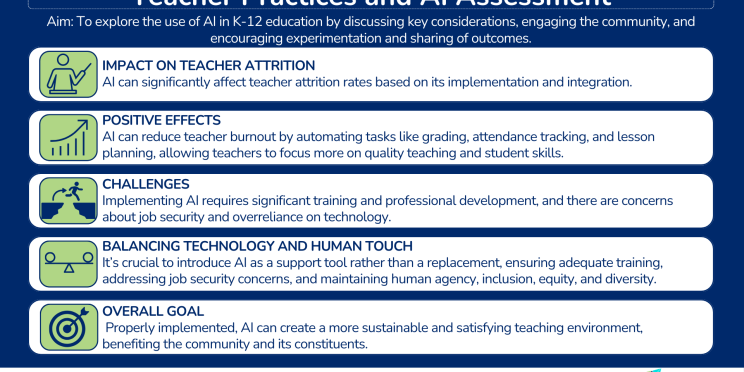
Artificial Intelligence Chapter 2: Teacher Practices and AI Assessment
In the ever-evolving landscape of education, the integration of artificial intelligence (AI) promises to significantly transform teacher practices and student assessments. Chapter two of Inclusive Intelligence, Teacher Practices and AI Assessment, delves into this transformative potential, highlighting how AI can alleviate the administrative workload of educators, reduce teacher burnout, and tailor assessments to meet individual student needs. Here’s a comprehensive look at the insights and implications presented in the article.
Artificial Intelligence to Help Special Education Teacher Workload
Artificial Intelligence (AI) benefits various parts of our lives, and special education is no exception. AI tools, including generative AI such as ChatGPT, Gemini, and Copilot, have the potential to support teachers and enhance inclusion in education. In July, CIDDL hosted a three-part webinar based on the publication exploring how AI can help with special education teacher workload, featured by Sean Smith, Ph.D., Juli Taylor, Ph.D., Adam Carreon, Ph.D., and Samantha Goldman. This blog post briefly summarizes the webinar on the potential of AI in special education, the current crisis facing special education teachers, how AI can help reduce their workload, and its application in student-facing tasks.
The Integration of AI Chatbots in Education for Preservice Teachers
Artificial intelligence (AI) chatbots in education are revolutionizing the preparation of pre-service teachers, transforming how they access learning and instructional resources. These educational assistants offer numerous benefits and opportunities, but practical implementation requires careful and critical evaluation. This blog explores the current use of AI chatbots in education, their benefits, and the need for critical assessment in their application.
Considerations for Syllabi in a Gen AI World
While it may seem like forever since ChatGPT and the related generative AI explosion began to revolutionize education, it has only been 20 months. That means this is only the second fall semester where faculty need to intentionally plan for its integration and the related redesign of their courses. Thus, it is important to explore resources to support the further integration of AI into preparation program syllabi.
Can AI Help With Special Education?
Teachers have been experiencing increased efficiency in handling paperwork thanks to artificial intelligence (AI). However, using AI for instruction for students with disabilities and learning differences is still challenging and requires a cautious approach. A recent article from Education Week, “Can AI Help With Special Ed? There’s Promise and Reason to Be Cautious,” explores the potential and challenges of AI in special education. This article is based on insights from a June 25 panel discussion at the International Society for Technology in Education (ISTE) conference, featuring our CIDDL PI’s Trey Vasquez Ph.D., a professor at the University of Central Florida, and James Basham Ph.D., a professor at the University of Kansas.
CIDDList: Replacements for Your Retiring Favorites
If you haven’t heard, Google is retiring Jamboard and Microsoft is limiting availability of Flip to those with Teams accounts. While this news may require some revisions to courses and classrooms, it provides an opportunity for teacher-educators and special education personnel to leverage newer innovations in their curriculum. Thus, in this CIDDList, we will highlight tools you can use in place of these well-loved sites.
Apple Intelligence: How Apple’s AI for the Rest of Us Will Impact Special Education Personnel Preparation
In a much-awaited gathering, Apple announced how it is upgrading its devices to integrate further artificial intelligence, or Apple Intelligence (AI), as they call it. Apple devices have used natural language processors, a type of AI, for years to create SIRI and their word prediction software. Unlock your phone with your face? That also uses AI. At this most recent event, though, they announced how they use generative AI to enhance their platforms. Apple is branding this upgrade as AI for the rest of us, making using the novel, albeit sometimes complex, AI features more user-friendly.